
FX pricing is quietly driving or killing cross-border conversion
By Guy Langlev, Risk Analyst at Grain, and Shahaf Goren, Lead Data Scientist at Grain
TL;DR:
Most cross-border platforms update FX pricing once per day. That small operational choice quietly costs real bookings.
Grain’s analysis of more than 1 million transactions shows that when FX pricing is refreshed more frequently - even every 15 minutes - customer-facing prices stay closer to market conditions, appear more competitive at checkout, and booking completion rises measurably. Read the full analysis:
Where conversion leaks
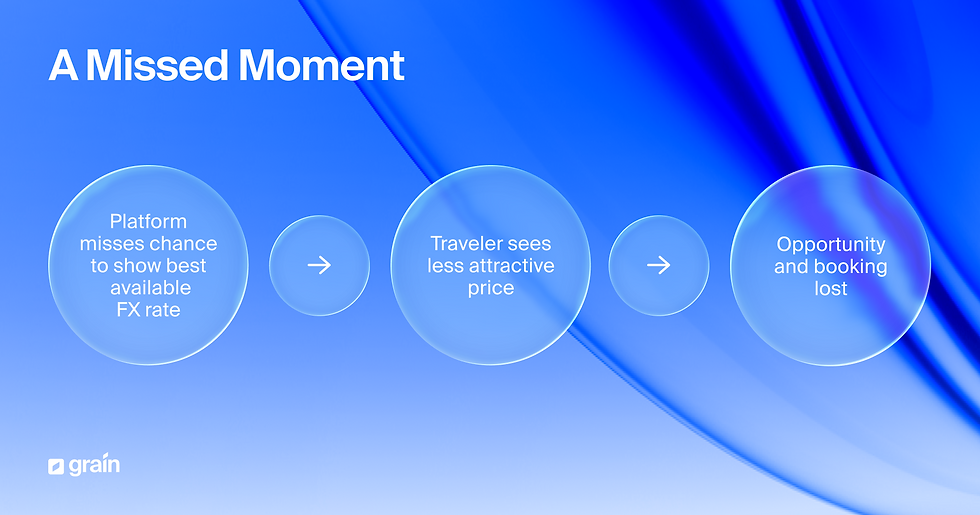
Once-a-day FX pricing guarantees stale prices at the moment of conversion.
Most platforms still refresh FX once per day. By the time a traveler reaches checkout, that rate is already outdated. Even small intraday currency moves can make a price feel slightly worse than expected. In competitive booking flows, that hesitation is all it takes to lose the sale.
The fix: more frequent FX updates
Updating FX every 15 minutes, or in real time, keeps customer-facing prices aligned with the market. That means travelers see fair, timely rates, and platforms stay competitive across currencies.
More frequent FX updates reduce price drift without requiring large safety buffers. Platforms can protect margins while presenting prices that reflect current market conditions.

What the data shows
Across major corridors, customer-facing prices based on fresher FX updates were more competitive at checkout in 88–98% of observed moments, compared to once-a-day pricing.
This does not mean prices were always lower. Markets move both ways. It means that static daily rates drifted away from market reality more often, making displayed prices less competitive relative to alternatives.

The commercial impact
Even modest improvements in customer-facing FX pricing correlated with meaningful changes in booking completion.
In high-volume booking funnels, a 3–5% uplift in completion rates can represent millions in incremental revenue annually.
Think about it this way: in a funnel handling tens of thousands of transactions per day, a few percentage points of lift is equivalent to millions in incremental revenue.
Why this matters
Dynamic FX can move both ways. Prices may tick slightly up or down. What matters commercially is that they feel real, predictable, and defensible - not padded for safety or stale due to infrequent updates.
Consistency builds credibility: when prices behave predictably, users attribute fairness to the brand. Over time, that trust compounds into loyalty and repeat bookings.
The takeaway
FX pricing is no longer just a treasury setting. It is a visible part of the customer experience - and a measurable driver of cross-border conversion.
Once-a-day rates create friction. Real-time rates create confidence.
The data is clear: platforms that keep their FX pricing current convert more customers and compete more effectively across markets.
Here you can look at the full PDF version of our analysis.
Take the industry pulse
How often do companies actually update their FX, and how many still rely on buffers?
We’re running a short survey to understand how platforms protect against currency moves today.
Take the 2-minute survey here. We'll share the results on our LinkedIn page soon.
This analysis is provided for informational purposes only and should not be construed as financial, investment, or professional advice.


Trước đây mình hay đánh theo cảm giác, thấy con nào “có vẻ về” là vào nên hụt lên hụt xuống. Từ lúc chịu khó ghi lại cầu kèo, rồi mới chốt số thì đỡ loạn hơn hẳn. Gần đây mình thử lọc theo khung cho gọn, hợp kiểu bận rộn vì không phải ngồi soi quá nhiều. Có đợt mình áp dụng Lô khung song thủ 3 ngày, chọn đúng cặp mình hay theo và giữ nguyên đến hết kỳ, không đổi giữa chừng nên tâm lý nhẹ hơn. Dĩ nhiên vẫn có ngày trượt, nhưng mình tự nhắc phải chia vốn và biết dừng, chứ càng nóng càng dễ mất kiểm soát. Mình còn hay so lại tần…